Artificial Intelligence Framework
What is Artificial Intelligence?
Artificial Intelligence (AI) encompasses all techniques that allow machines to learn, reason or generate outputs in a human-like way based on data.
AI can be broadly divided into two main areas:
1. Machine Learning
Machine Learning is the branch of AI where we teach machines to learn patterns from data, without explicitly programming rules for every possible case.
Within Machine Learning, there are different types of models:
-
Simple models based on mathematical functions, such as:
- Linear regression: predicting the price of a house based on its features.
- Logistic regression: classifying whether a process or request was successful.
-
More complex models, such as:
- Decision trees and random forests, which combine multiple decision rules.
- Clustering models, which group similar data when no target variable is known (for example, segmenting users without labels).
📘 Supervised vs. unsupervised learning
- In supervised learning, the system learns using a known target variable (e.g. house price or whether a process was completed).
- In unsupervised learning, no predefined answer exists, and the goal is to discover hidden structures or patterns in the data.
2. Deep Learning
Deep Learning relies on artificial neural networks, inspired by the human brain.
These networks consist of multiple interconnected layers of neurons, where each
connection performs a simple mathematical operation.
In practice, Deep Learning is about millions of simple operations executed in parallel, enabling advanced capabilities such as speech recognition, computer vision or text generation.
Within Deep Learning we find generative AI, capable of creating new content:
- Text: ChatGPT, Claude, Gemini
- Images: DALL·E, Midjourney, Stable Diffusion
- Audio, video or code: specialized models depending on training data
How we apply AI at DKY Labs
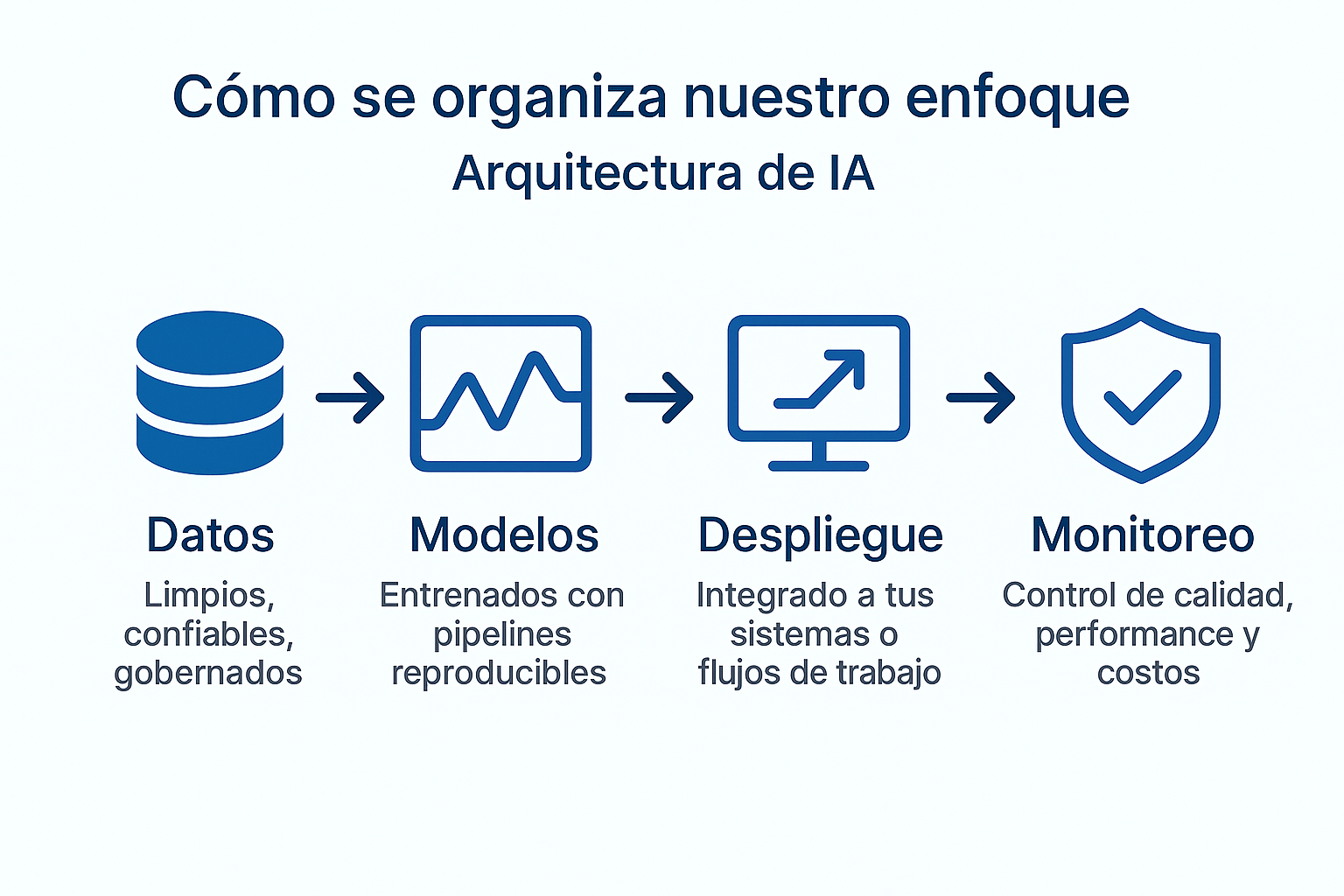
At DKY Labs, we integrate these models into enterprise-grade solutions by combining:
- Governed, high-quality data
- Reproducible learning processes
- Controlled deployment through MLOps
This ensures solutions that are reliable, scalable and aligned with real business goals.
How our approach is structured